
IDOC Release Paths Statewide
No state prison was identified inside Marshall County. The Illinois Department of Corrections operates facilities statewide, and a person sentenced in a Marshall County case may be committed to one of them. That move is a transfer from county custody, not a community release. Once IDOC accepts the person, the statewide IDOC record becomes the main public route for prison status and release dates.
A person may later leave prison on parole or mandatory supervised release, often shortened to MSR. Both place a person in the community under state conditions. They are not final discharge. Some older indeterminate cases and eligible youthful-review cases involve a Prisoner Review Board decision. Many determinate sentences move to MSR under the sentence and law rather than through a traditional discretionary parole grant.
| IDOC record | Meaning |
|---|---|
| IN CUSTODY | The person remains in IDOC custody |
| PAROLE plus actual Parole Date | Prison custody ended and supervision continues |
| Projected Parole Date | An estimate, not proof of departure |
| Projected Discharge Date | A forecast, not final completion |
| Actual final-discharge action | Evidence that the named supervision or sentence ended |
Search IDOC Release Records
Open the IDOC Individual in Custody Search and follow its search link. An IDOC number gives the cleanest match. Identity fields can also help, but names alone may join two different people. Compare the name, birth date, physical details, sentencing county, offense and sentence information, and the public record’s “as of” date.
The successful manifest capture below comes from the official IDOC legacy search form.
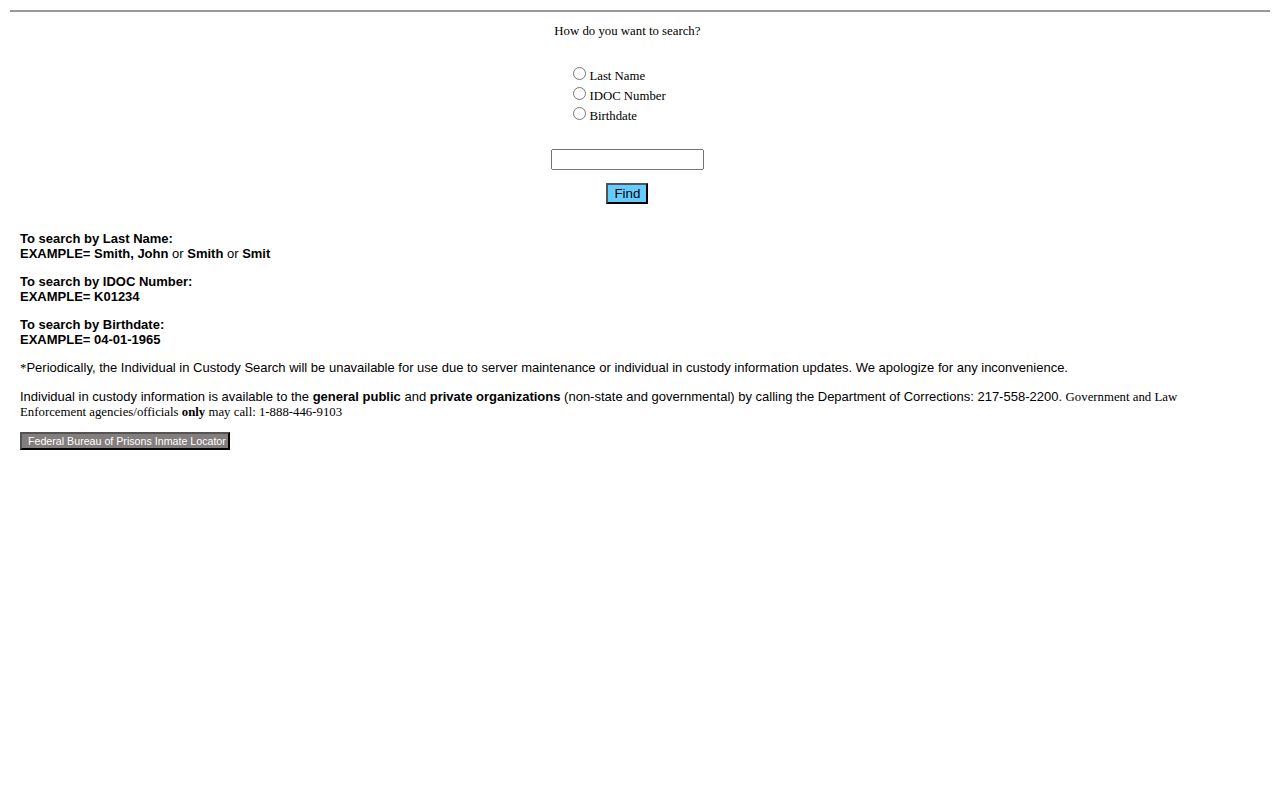
The form confirms that statewide IDOC identifiers, not a county jail booking list, drive this search.
- Search by IDOC number when it is known.
- Match identity and the Marshall County sentence information.
- Read Offender Status and location before any projected date.
- Record the page’s “as of” date and every actual event date.
- Review each sentence row and seek IDOC records when fields conflict.
The Marshall County release search covers the Sheriff and court steps that show how a local case reached IDOC.
Read IDOC Release Fields
The public record contains more than one date. Common fields include the IDOC number, name, photograph, parent institution, status, location, admission date, Projected Parole Date, Last Paroled Date, Projected Discharge Date, and sentence rows. Those rows may show the mittimus, class, count, offense, custody date, sentence, county, and whether one sentence is discharged.
A “Sentence Discharged? YES” row does not always settle the whole record. Another count or supervision duty may remain. Read all rows. “Last Paroled Date” describes a past event, while “Projected Parole Date” is a forecast. An `IN CUSTODY` status defeats a release claim even when a projected date is today or has passed.
The official current-custody example shows how projected fields appear beside an in-custody status.
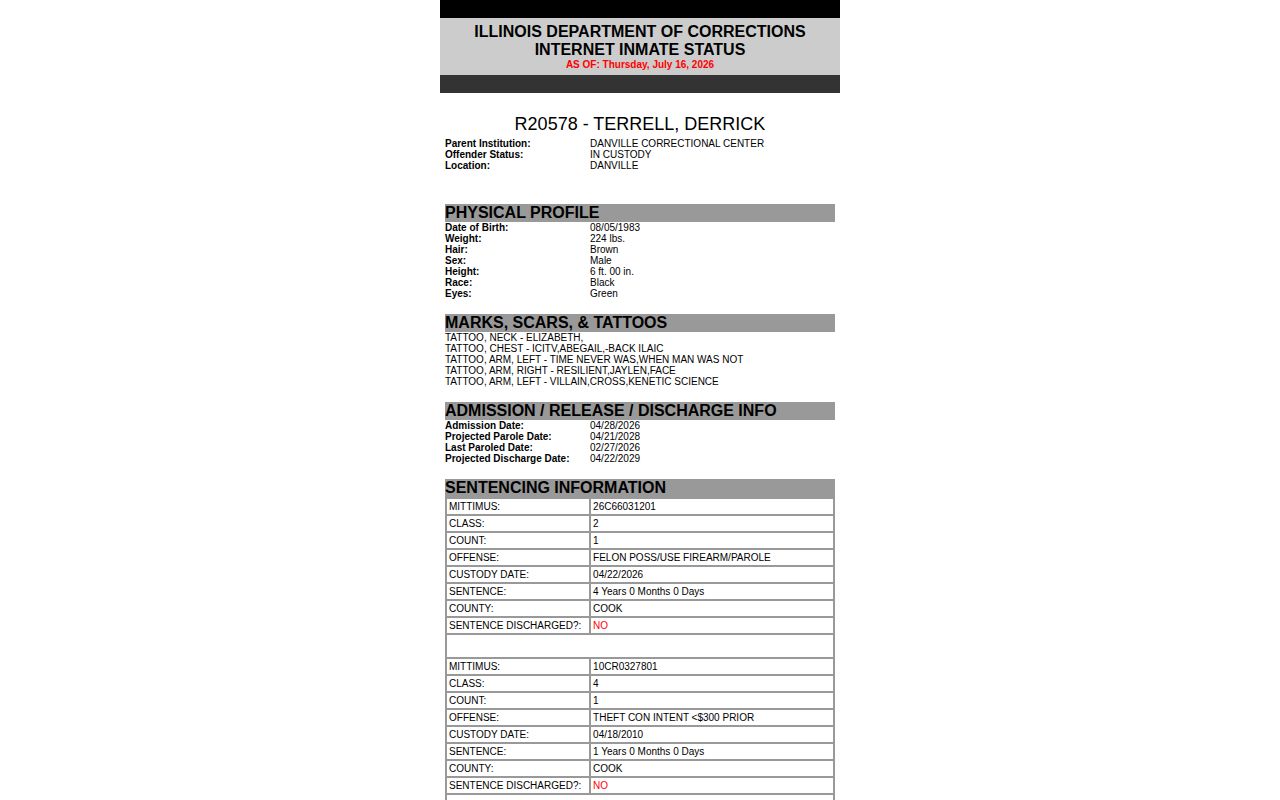
This example must not be labeled as a released person. Its value is the field structure and the clear warning that forecasts do not override present custody status.
- Parole
- Release from prison into state supervision under conditions.
- Mandatory supervised release
- A required supervision period that follows many determinate prison terms.
- Final discharge
- The later end of the supervision or sentence identified by the discharge action.
- Mittimus
- A court document directing commitment or custody.
Verify IDOC Parole Release
When a record says `PAROLE`, confirm an actual Parole Date and note the parole district. That combination supports the limited statement that institutional custody ended and state supervision began. It does not prove sentence completion, a home address, or freedom from another case. A projected discharge date remains a forecast.
For an indeterminate or youthful-review case, consult the Prisoner Review Board En Banc results. Read the result, not merely the schedule. A grant authorizes release, but the IDOC actual status and date show implementation. A denial or deferral does not show departure. Revocation results can return a person to release, alter conditions, await plan approval, or revoke release and return the person to IDOC.
Final completion is separate. Seek an actual IDOC discharge status or Prisoner Review Board early final-discharge action. State the conclusion in two parts when needed: prison custody ended on one date, and state supervision ended on another. That phrasing preserves the record’s legal and time limits.
Note: A hearing calendar shows that a proceeding was scheduled; it does not disclose the result or prove an IDOC facility release.
IDOC Release Records Contact
IDOC’s Public Information Office can address questions about a public result. A formal request for admission, release, and discharge history belongs with the IDOC FOIA office. Give the full identity, IDOC number, sentencing county, and a bounded date range. Ask for the specific history or field that needs correction or confirmation.
Illinois Department of Corrections1301 Concordia Court
P.O. Box 19277
Springfield, IL 62794-9277
217-558-2200IDOC FOIA Office
DOC.FOIARequest@illinois.gov
Fax: 217-558-5612
Status: 217-558-2200 ext. 4166
IDOC publishes the first fifty ordinary black-and-white pages at no charge, then fifteen cents per page. Letter-size color pages are fifty-nine cents, and other formats may be charged at actual cost. Privacy and law-enforcement exemptions can limit details available to a third party. A subject or authorized representative may have access routes not open to a general requester.
The IDOC public-records instructions are shown in this matching manifest image.
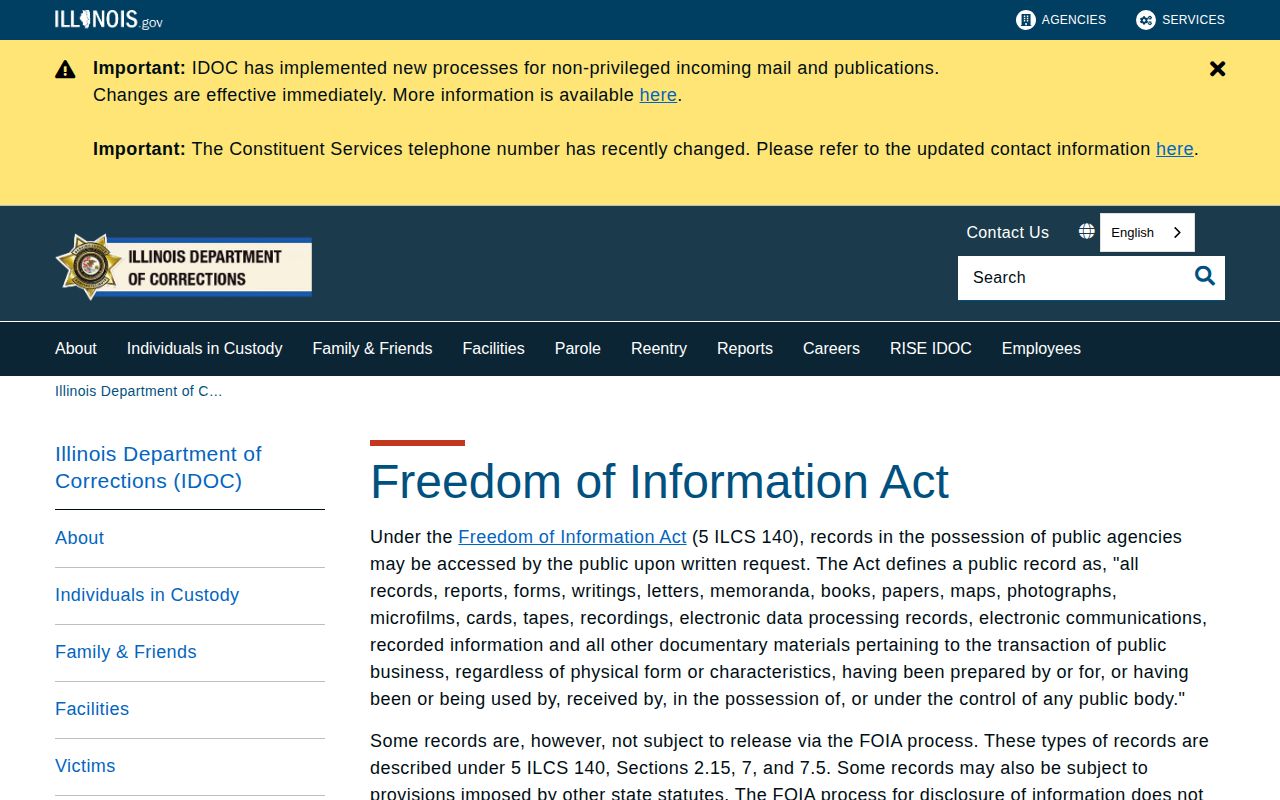
Those instructions supply the correct statewide record route when a public person page is incomplete or disputed.
IDOC Versus Marshall Jail Release
The Marshall County Jail and IDOC answer different questions. The Sheriff tracks a local booking and the date, time, and authority for discharge, transfer, or release. IDOC tracks a state-prison commitment, prison location, actual parole events, projected dates, and sentence rows. A person can leave the Marshall jail for IDOC while remaining fully in custody.
| Last known system | Correct route | Proof sought |
|---|---|---|
| Marshall County Jail | Sheriff record and county court | Local departure type and time |
| IDOC prison | IDOC search and IDOC FOIA | Status, actual parole, or discharge |
| Federal sentenced custody | BOP locator | Past release date and released status |
| ICE custody | ICE ODLS | Current or recent ICE status |
If the county record names IDOC, search by IDOC number and match the mittimus and sentence county. If it names another system, do not use the IDOC search to fill the gap. Each locator speaks only for its own custody. The sibling Marshall County Jail release page gives the direct local record route.
IDOC Date Changes Explained
IDOC calculates projected dates from the court sentence, custody and jail credit, concurrent or consecutive structure, credit eligibility, awarded or revoked credit, supervision terms, and later legal changes. A corrected mittimus, new conviction, disciplinary credit loss, restored credit, program credit, or statutory recalculation may move the forecast. The result is informational and can change.
Illinois law is offense and date specific. Some convictions limit credit in ways commonly described as requiring eighty-five percent service. Other categories require all, seventy-five percent, or another share, while some eligible sentences receive day-for-day statutory credit. Never apply one percentage to every IDOC sentence. The exact conviction, date, and sentence structure control.
No published Marshall County jail good-time formula can replace this statewide prison analysis. For a county term, obtain the judgment, jail-credit statement, and Sheriff release entry. For an IDOC term, preserve the live record date and confirm the actual event after the projection passes.
IDOC Release Source Conflicts
IDOC, the Prisoner Review Board, the sentencing court, and VINE can each display a different stage of one release. A Board grant is authorization. The IDOC actual status and parole date show implementation. A VINE message is a notification from an agency interface. The court record supplies the sentence and later corrections to the mittimus. None should be silently substituted for another.
Compare timestamps before treating different values as an error. A projected date may change after credit recalculation. A Board result may appear before the institution completes release planning. A VINE alert may arrive after the IDOC record changes. Preserve the “as of” date, event label, IDOC number, and every sentence row so the conclusion can be checked later.
If the record remains incomplete, ask IDOC for the admission, release, and discharge history covering a narrow period. A subject or authorized representative may be able to obtain details not released to the general public. State only what the available record proves and identify the custody system by name.
Note: An IDOC public no-result does not establish a county-jail release, federal release, or immigration outcome; check the system that held the person.