
Marshall Projected Versus Actual Release
A projected release date is a calculation based on facts known to the agency at that time. IDOC calls its main forecast fields Projected Parole Date and Projected Discharge Date. The first estimates when the prison portion may end and parole or mandatory supervised release may begin. The second estimates the later end of the sentence and supervision structure shown in the record. Neither is an actual event.
Actual fields answer a different question. “Parole Date” or “Last Paroled Date” records a past parole event. A Sheriff entry records the date, time, and authority for a local discharge, transfer, or release. An actual final-discharge decision can show that the supervision named by that decision ended. Each record has a distinct scope.
A pretrial detainee does not have a sentence-based release date. A judge may enter pretrial release terms, but processing can follow later. The court order supplies authority, while the Marshall County Jail entry supplies the departure time. A transfer to IDOC also ends the county stay without placing the person in the community.
Find Marshall Projected Release Dates
Classify the last known custody first. For an IDOC commitment, use the IDOC Individual in Custody Search. An IDOC number gives the cleanest match. Confirm the name, birth date and physical details, sentence county, offense data, and all sentence rows. Save the record’s “as of” date because public values can change.
The official current-custody example demonstrates the forecast fields without proving a release.
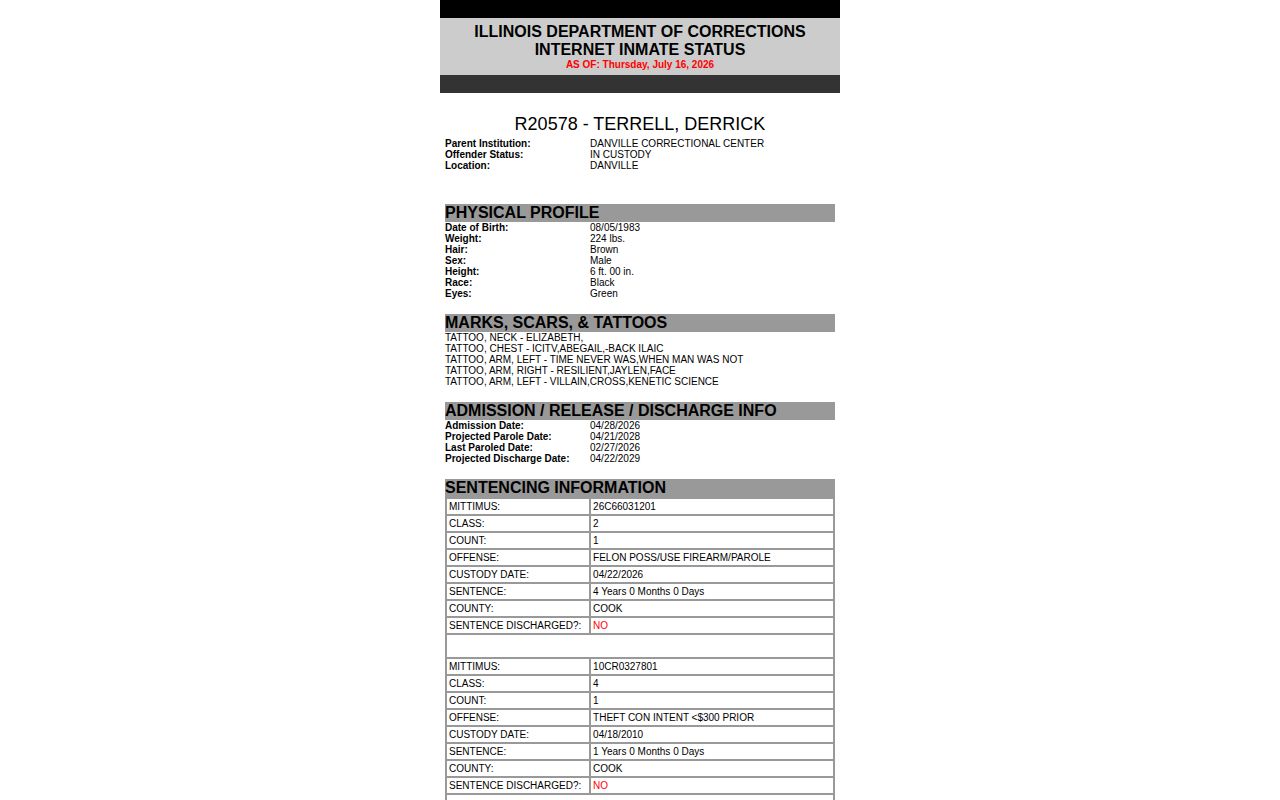
The displayed `IN CUSTODY` status shows why projected parole and discharge dates must not be reported as completed events.
- Identify whether the person is in the Marshall County Jail, IDOC, federal custody, or another system.
- Use the stable booking, case, IDOC, or federal register number when available.
- Read present status before any projected date.
- Record actual parole or release fields separately from forecasts.
- Confirm the event with the agency record after the projected date arrives.
For a Marshall County jail term, call the Sheriff at 309-246-2115 and obtain the judgment, jail-credit statement, and release record. No local public calculator, good-time policy, or weekend-release convention was found. The Marshall County release records route explains how to match the jail entry with the county court order.
Marshall Sentence Credit Rules
The calculation begins with the sentence imposed by the court and the custody credit stated or lawfully applied. IDOC then accounts for concurrent or consecutive sentences, statutory credit eligibility, credits awarded or revoked, parole or MSR terms, and later recalculation. Concurrent terms run together to the extent ordered. Consecutive terms run one after another. A mittimus is the court document directing commitment and is central when sentence data needs correction.
730 ILCS 5/3-6-3 is offense and date specific. Some listed convictions receive no more than 4.5 days of credit per month, often described as serving 85 percent. Other categories require 100 percent, 75 percent, or another statutory share. Eligible cases outside those groups may receive one day of credit for each day served. Program and service credits have separate rules, caps, and qualifications.
No universal “Illinois inmates serve 85 percent” rule exists. Applying that figure without the exact conviction and controlling date can produce a false forecast. IDOC’s sentence-calculation directive also addresses aggregation, statutory credit awards and revocations, and changes made at the projected release point. The live person record remains informational and may be updated.
- Jail credit
- Time credited toward a sentence for qualifying prior custody.
- Statutory credit
- A sentence reduction allowed by law for an eligible person and offense.
- Projected parole date
- IDOC’s current estimate for leaving confinement to supervision.
- Projected discharge date
- IDOC’s current estimate for the later sentence or supervision end.
Why Marshall Release Dates Change
A projection can move in either direction. IDOC may add or restore eligible credit, or revoke credit after discipline. A corrected court order may change jail credit or the sentence structure. A new conviction or consecutive sentence can extend the calculation. Statutory changes and agency recalculation can also alter what the public page shows.
| Change | Possible effect | Record to check |
|---|---|---|
| Credit earned or restored | May move forecast earlier | IDOC calculation and person record |
| Credit revoked | May move forecast later | Discipline and calculation record |
| Corrected mittimus | May change credit or term structure | Filed court order and IDOC update |
| New or consecutive sentence | May extend custody | All sentence rows and court cases |
| Detainer or receiving agency | May prevent community release | Agency and transfer record |
| Parole or revocation result | May authorize release or return | PRB result plus actual IDOC status |
A detainer is a request or legal notice that another agency may take custody. It can change the destination even when one sentence reaches its expected end. The first agency’s “release” may be a transfer. Confirm the receiving system before stating that the person entered the community.
Note: A projected date can be correct when published and still change later because the facts or governing calculation changed.
Verify Marshall Parole Dates
A public IDOC record marked `PAROLE` should also show an actual Parole Date before it is treated as proof that prison custody ended. Note the parole district. The result supports release from the institution to state supervision, not sentence completion or a specific physical location. A sentence row marked discharged may cover only one count while another obligation remains.
For eligible indeterminate or youthful-review cases, consult the Illinois Prisoner Review Board results. A scheduled hearing proves only that a proceeding was planned. A grant is authorization, while IDOC’s actual date and status confirm implementation. A denial or deferral points the other way. Revocation results may return a person to release, alter terms, await an approved plan, or revoke release and return the person to IDOC.
Most determinate Illinois sentences do not await a conventional parole vote. They move into mandatory supervised release under the sentence and law. For final completion, seek an actual final-discharge action or IDOC discharge status. It is often most accurate to state two dates: institutional custody ended first, and supervision ended later.
Marshall Jail Date Evidence
Marshall County does not publish an official online projected-release calculator or recent-release archive. A county detainee awaiting trial has no sentence forecast to calculate. Search the county-coded Judici docket for the order, then contact the Circuit Clerk for the filed or certified version when exact wording matters. A bond or pretrial order may authorize release without timestamping jail completion.
For a sentenced jail term, ask for the judgment, sentence, and custody credit. Then request from the Sheriff “the record showing the date, time, and authority for discharge, transfer, or release” for the identified booking. That wording tracks Illinois jail inspection controls. It also avoids asking the agency to create an estimate that does not exist.
No official research established a Marshall County weekend adjustment, holiday practice, local good-time formula, standard processing time, or promised exit. Do not infer one from another Illinois jail. If a date matters for travel or personal coordination, verify it directly and allow for a court hold, agency transfer, or processing change.
Confirm Marshall Release Alerts
Illinois VINE can add a prospective notification layer. Search the person by name or identification number, select the matching agency record, and register for an available phone, text, email, or app alert while the person remains eligible. Phone registration uses a four-digit PIN to confirm receipt. A VINE alert may concern release, transfer, escape, or another custody change, so preserve the exact event label.
A notification is not a certified release record. It may lag the source agency, and a transfer alert does not mean freedom. Compare it with the IDOC actual status or Sheriff release entry. The Marshall County VINELink check covers registration and status limits in detail.
If IDOC data appears incomplete, request the relevant admission, release, and discharge history from IDOC FOIA at 1301 Concordia Court, P.O. Box 19277, Springfield, IL 62794-9277. Include the IDOC number, full identity, sentence county, and date range. The public result, agency response, and query date should remain together.
Marshall Date Source Conflicts
Several dates can describe one event without matching exactly. A judge may sign an order in the morning, jail staff may finish processing later, and VINE may send an alert after the agency feed updates. Those timestamps are compatible if each source is labeled. The court order answers what was authorized. The jail or IDOC entry answers when the custody system recorded departure. A notification answers when a message was generated or delivered.
When two sources seem to disagree, compare the person identifiers, custody system, event label, and query time before choosing a conclusion. A later arrest can make an old release alert and a new custody record both accurate. A projected date saved last month can differ from a current projection after recalculation. Preserve the older capture instead of silently replacing it, then state which version was current on each date.
The safest conclusion is narrow: “IDOC listed a projected parole date as of the recorded query,” or “Marshall County Sheriff custody ended at the time shown in the release entry.” Avoid present-tense claims when the source proves only a past event. If the record says transfer, identify the receiving system before calling it community release.
IDOC Release Record Requests
When the public result does not explain a changed forecast, ask IDOC for the admission, sentence-calculation, release, and discharge records that cover the disputed period. Give the full name, IDOC number, Marshall County sentence, and exact dates. Ask for electronic records and segregable nonexempt portions. A subject or authorized representative may have access to details that are not released to a general requester.
IDOC lists its FOIA office at 1301 Concordia Court, P.O. Box 19277, Springfield, Illinois 62794-9277. Requests may be sent to DOC.FOIARequest@illinois.gov, and status questions go to 217-558-2200 extension 4166. Preserve the response with the public page and court order so later changes remain traceable.
Note: IDOC’s public values are time-stamped snapshots. Save the query date, full status panel, every sentence row, event label, and matching identifier before comparing a later calculation or reporting a changed date.