
Marshall County Parole Versus Probation
The words are often treated as if they mean the same thing. They do not. Illinois parole and mandatory supervised release, often shortened to MSR, concern a person released from an IDOC institution while state supervision continues. The Illinois Prisoner Review Board sets conditions, addresses revocation matters, and can review early final discharge. IDOC parole field operations supervise the person, and the IDOC public record may name a parole district.
Probation is imposed by a court. A Marshall County probation order can begin without any IDOC prison release. It is administered through the Marshall-Putnam-Stark Probation District and documented in the court case. A third status, pretrial supervision, applies before a criminal case reaches final judgment. It is not probation, parole, or proof that a sentence ended.
| Status | Who creates or supervises it | Best verification source |
|---|---|---|
| Parole or MSR | IDOC and the Illinois Prisoner Review Board | IDOC person record, actual parole date, PRB result, and any final-discharge action |
| Probation | Marshall County court and the three-county probation district | Filed judgment, disposition, later court order, and lawful confirmation from the local office |
| Pretrial supervision | The court and Illinois Office of Statewide Pretrial Services | Current pretrial order and the court docket |
Supervision terms
Parole or MSR is community supervision after the prison portion. Probation is a court sentence served under stated conditions. Discharge is an official end to the supervision identified by the order. Revocation is a decision withdrawing release and may return a person to custody.
Verify Marshall County Post-Release Status
Begin with the claimed status, not the person's disappearance from a jail list. A name leaving Marshall County Jail could mean release on a court order, transfer to IDOC, movement to another authority, or another event. The Marshall County release-record guide explains how to establish that physical departure. Supervision requires another layer of proof.
- Collect the exact name, case number, and a stable IDOC number when one exists. Keep separate cases and custody episodes separate.
- For a claimed parole or MSR status, search the official IDOC Individual in Custody Search. Read the “as of” date, offender status, location, actual parole date, projected dates, parole district, and every sentence row.
- If the IDOC record says “PAROLE,” confirm that an actual parole date appears. A projected parole date alone is not a completed release.
- Review the Illinois Prisoner Review Board result when the issue involves an en banc parole decision, revocation, conditions, or early final discharge. A hearing schedule is not an outcome.
- For probation, search the Marshall County court docket through the Circuit Clerk's county-coded Judici link. Find the filed judgment, probation order, later modification, violation order, or termination.
- Contact the Marshall-Putnam-Stark Probation District for program or office guidance and any confirmation it may lawfully provide. Do not assume office staff can disclose a person's protected details.
One record may not answer the whole question. An IDOC sentence row marked discharged can refer to only one count while another sentence or supervision term remains. Likewise, a probation termination does not reveal when jail custody ended. Match the source to the precise event.
Marshall County Probation Office Contacts
The local court-probation office is the Marshall-Putnam-Stark Probation District. Its Marshall County location is in Lacon. This office is not the Prisoner Review Board, not IDOC parole field operations, and not a jail locator. Use it for court probation and local program navigation.
Marshall-Putnam-Stark Probation District
Address: 122 N. Prairie Street, P.O. Box 328, Lacon, IL 61540
Phone: 309-246-8604
General email: probation@marshallcountyillinois.gov
Chief: Megan Spradling
Marshall/Stark officer: Amelia Johnson, mcprobation@marshallcountyillinois.gov
Marshall/Putnam officer: Samuel Wier, pcprobation@putnamil.gov
No general statewide public probation-person lookup was found. The stronger public route is the filed Marshall County order, followed by a focused office inquiry where disclosure is allowed. Use the case number and exact order date. Do not ask the office to infer status from a name alone.
The official Marshall County probation page shows the district structure and local contact route.
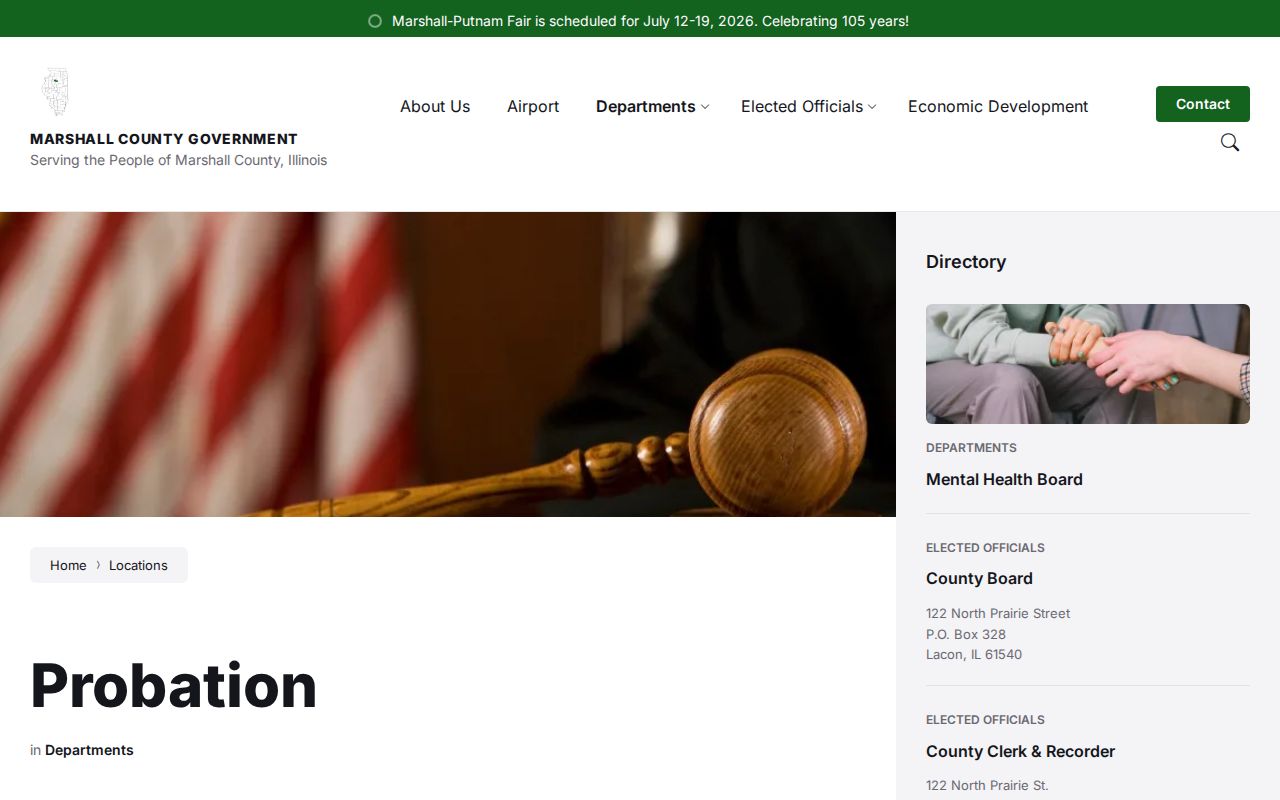
This local page supports office routing. It should not be treated as a public list of people under supervision.
Three Marshall County Supervision Systems
Marshall County's structure makes precise terms especially important. Court probation is administered through one district shared with Putnam and Stark counties. State parole and MSR appear through IDOC and the Prisoner Review Board. Pretrial services at the Marshall County Courthouse operate under the Illinois Office of Statewide Pretrial Services. Each system answers a different legal question.
A court-ordered pretrial release does not show that a person served a sentence or entered probation. Probation does not show a prior state-prison release. “PAROLE” in an IDOC record does not mean final discharge. When explaining a person's record, name both the system and the date: for example, release from IDOC institutional custody on parole is different from a later end of parole supervision.
Documents should be reconciled by role. The Sheriff record establishes the county jail's physical action. The filed court order states the court's authority or sentence. IDOC shows state prison and parole fields. PRB decisions address board action, and the local probation office handles court probation. This keeps a transfer from being mislabeled as community release and prevents pretrial supervision from being mislabeled as probation.
Marshall County Rural Probation Support
The shared district was selected for the Illinois Courts' 2024 Reaching Rural fellowship related to substance-use challenges. The initiative included training, coaching, and possible implementation support. This is a distinctive part of the local supervision and support landscape because one rural office serves a three-county area.
The fellowship is not a person-search database. Selection of the district does not prove that any named person took part in a program or has a substance-use condition. Contact the probation district for general program navigation, eligibility information, or the proper local resource. Individual participation should never be inferred from the district's involvement in a broad professional initiative.
For record verification, return to the court order and local office. A support program can help explain available services, but it does not replace the filed judgment, establish compliance, or show that probation has ended.
Marshall County Violations and Revocation
Supervision conditions come from the controlling order or release decision. They may concern reporting, travel, treatment, contact, or other conduct, but no general summary should be substituted for the person's actual terms. A missed appointment or allegation is not, by itself, a final revocation outcome. Use the court or board record.
For state parole or MSR, PRB preliminary-revocation materials describe several possible results. Proceedings may find no violation and permit release to resume after plan approval. They may find a violation but return the person to release with conditions. A revocation can instead return the person to IDOC and lead to a recalculated date. Read the result, not merely the hearing calendar.
The public PRB pages help locate decisions. Open the current en banc results and match the person carefully.
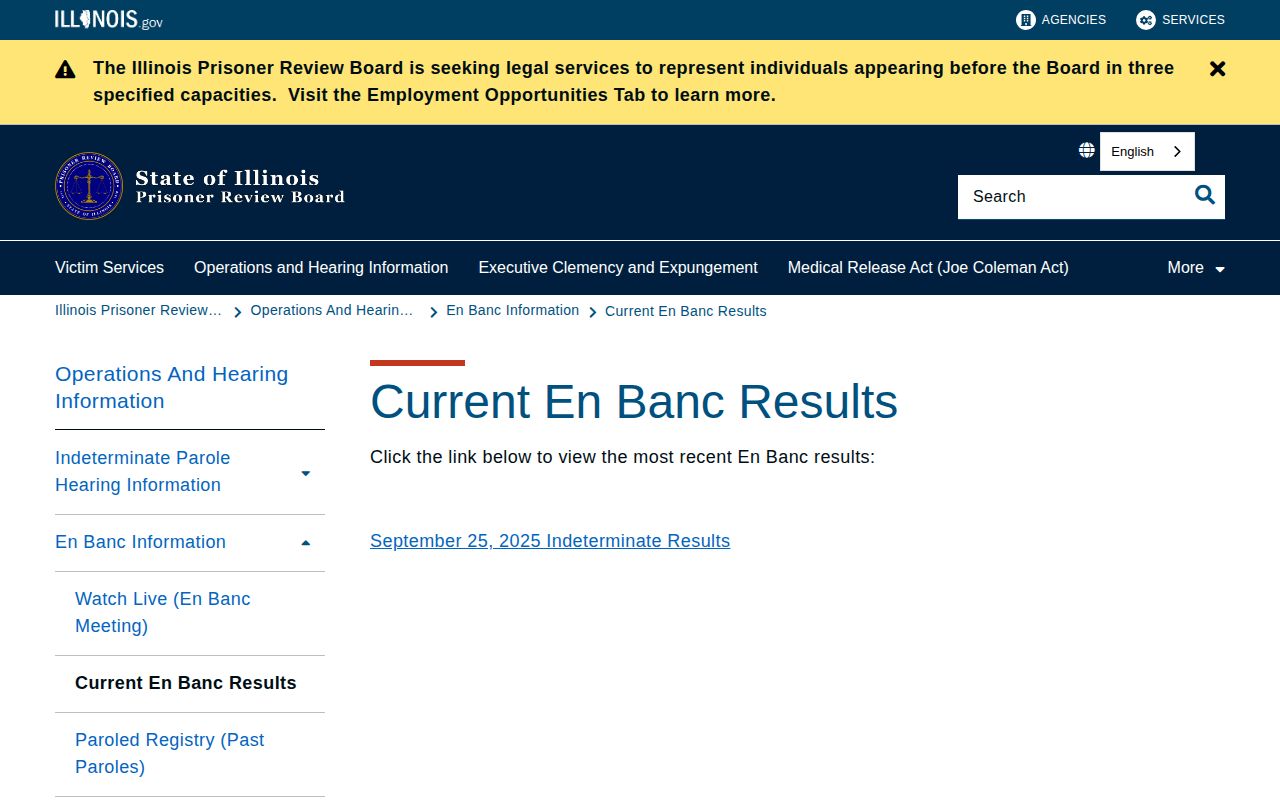
If a result orders return to release while IDOC still shows custody, allow for implementation timing and seek current confirmation. “Absconder” generally means a supervising agency alleges the person stopped reporting or cannot be located as required. It does not, without the official record, establish the current warrant or custody outcome. No verified public Marshall County absconder list was found.
Marshall County Parole Decision Records
For an indeterminate or youthful-parole matter, the Prisoner Review Board's en banc pages can add context that the IDOC person record does not show by itself. Match the name and IDOC number, then distinguish a grant, denial, deferral, or other result. A grant is authority for parole, not proof that IDOC implemented release that day. Confirm the actual parole date and current status in IDOC.
The PRB also publishes a historical Paroled Registry. It can support a past board grant, but it does not establish that supervision later ended. A denial generally means incarceration continues until another eligible review, subject to the controlling law and order. Every conclusion should pair the board action with the state corrections status closest to the event.
When Marshall County Supervision Ends
Final discharge requires an actual record. For state supervision, an IDOC projected discharge date remains a forecast. The Prisoner Review Board may consider early final discharge based on statutory standards and case factors, but eligibility or review is not the decision. Look for an actual discharge status, final-discharge action, or other completed agency record.
For court probation, use the Marshall County case docket and the filed termination or discharge order. Probation can be completed, modified, extended, revoked, or replaced by another court result. A projected end date or a period stated in the original judgment does not account for every later event.
State conclusions in two parts when needed. One date may show when institutional custody ended, while a second date shows when community supervision ended. This avoids saying a sentence was complete merely because prison release occurred. If sources conflict, record their dates and scope rather than choosing the easiest result.
A projected date is not discharge; verify completion through the actual court, IDOC, or Prisoner Review Board record.